
EdTech
Scholar Quest
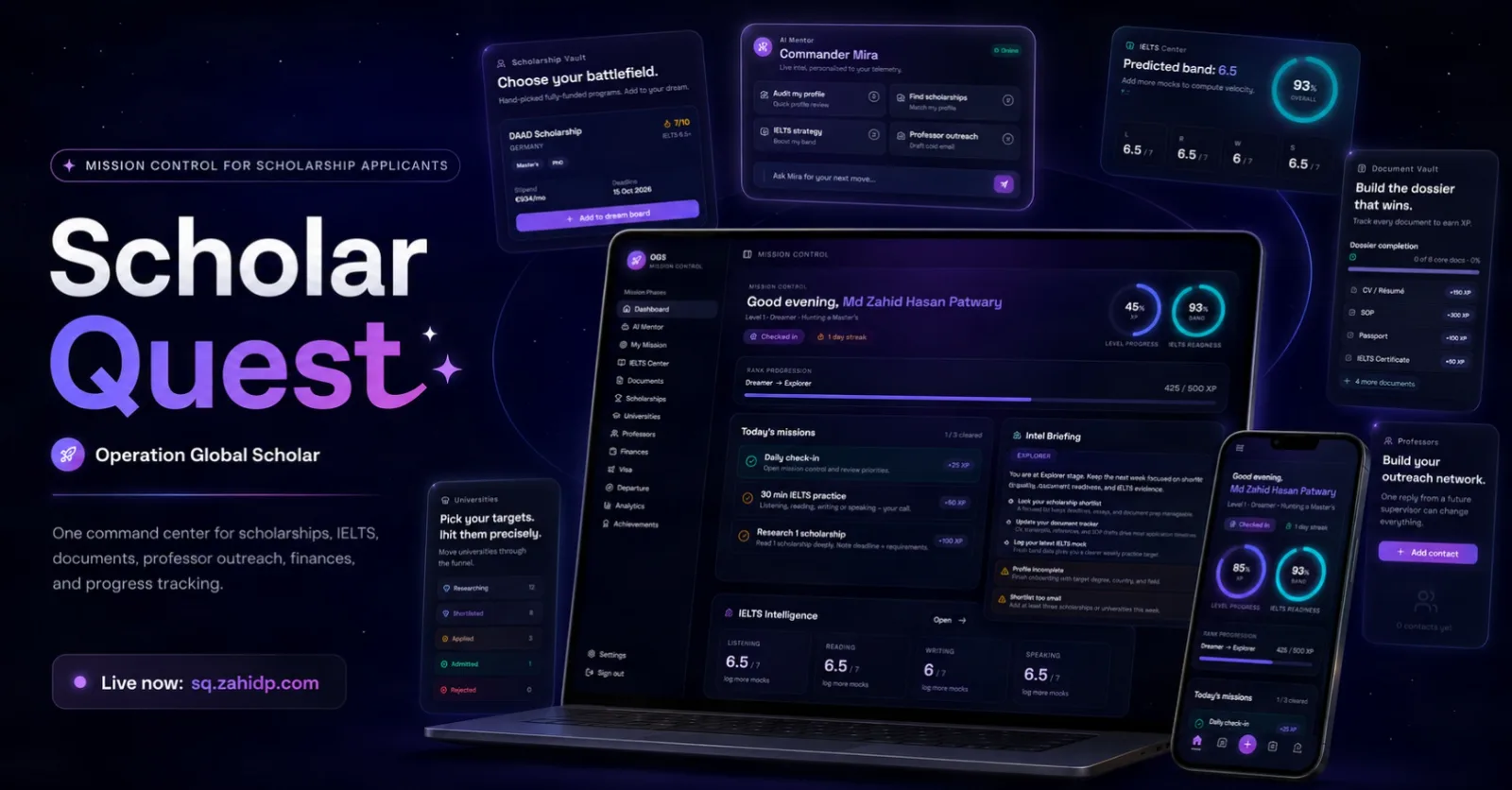
A full-stack command center that helps scholarship applicants manage university shortlists, IELTS preparation, application documents, professor outreach, finances, deadlines, and progress in one focused workspace.
Problem
A full-stack command center that helps scholarship applicants manage university shortlists, IELTS preparation, application documents, professor outreach, finances, deadlines, and progress in one focused workspace.
Solution
Built with React 19, TypeScript, TanStack Start to keep the workflow practical and maintainable.
Impact
One organized scholarship workflow
A scholarship application is not one task. It is an entire operating system.
When I started preparing for fully funded Master’s programs, especially Erasmus Mundus opportunities, I kept running into the same problem.
My university shortlist was in one spreadsheet. IELTS plans were in another note. Documents were spread between folders. Deadlines lived in calendars. Professor outreach was buried in email drafts. Finance planning was somewhere else again.
None of those tools were connected.
That made the process feel heavier than it needed to be. I was not only preparing an application. I was constantly trying to remember what I had already done, what was missing, and what needed attention next.
So I built Scholar Quest.
Scholar Quest is a full-stack study abroad command center for students preparing competitive scholarship applications. It brings the important parts of the journey into one focused workspace: scholarships, universities, IELTS preparation, documents, professor outreach, finances, deadlines, and daily progress.
Turning a scattered journey into one clear mission
The product begins with a dashboard designed to answer a simple question:
What should I focus on today?
Instead of showing disconnected data, the dashboard brings together daily missions, application readiness, progress levels, IELTS status, shortlist quality, document gaps, and practical next steps.
The system turns a long-term goal into smaller actions such as logging an IELTS mock, researching a scholarship, completing a document, or reviewing priorities for the day.
Shortlists should be strategic, not just saved links
Scholar Quest includes dedicated spaces for scholarship and university research.
Users can compare opportunities, track deadlines, note eligibility requirements, manage application stages, and move targets through a clear funnel from research to shortlist, application, admission, or rejection.
This makes it easier to see whether a scholarship plan is genuinely realistic or simply a collection of ambitious links.
IELTS preparation needs feedback, not just motivation
IELTS preparation can become vague very quickly. A student may know their target band but still have no clear idea which skill needs the most attention.
The IELTS Intelligence section lets users log mock-test scores across listening, reading, writing, and speaking. It then shows overall readiness, weak areas, estimated progress, and recommended practice priorities.
The goal is to make practice more focused. Instead of trying to improve everything at once, the student can see where the biggest gap is and act on it.
Documents, outreach, and finances are part of the same plan
A strong scholarship application also depends on details outside the exam score.
Scholar Quest includes a document vault for CVs, statements of purpose, transcripts, recommendation letters, passports, research proposals, and IELTS certificates. Each core document has completion progress and XP rewards to encourage steady progress.
The professor outreach area works like a lightweight academic CRM. It helps applicants organize potential supervisors, track communication, and avoid losing important outreach work in inboxes.
There is also a finance section for tracking savings, costs, and scholarship-related budgets, because application preparation often has real financial pressure behind it.
Consistency is a feature
Scholarship preparation can take months. Motivation naturally drops when progress feels invisible.
That is why I added daily missions, XP, levels, streaks, and achievements. The purpose is not to turn a serious application into a game. It is to make consistent work feel visible.
Small actions matter: one mock test, one document update, one researched scholarship, one carefully written professor email. Over time, those actions become a stronger application.
Building with security and context in mind
Scholar Quest uses Supabase for authentication, database management, storage, and row-level security. Each user’s application data, documents, finances, and planning information remain protected within their own account.
The AI Mentor runs through server-side functions and can use the authenticated user’s scholarship context to help with planning, IELTS strategy, document priorities, professor outreach, and weekly action plans. Daily message and voice-practice limits are stored and enforced through Supabase database functions.
The platform is built with React, TypeScript, TanStack Start, Tailwind CSS, Supabase, and Vercel.
What I learned
The biggest lesson from building Scholar Quest was that productivity tools should not only store information.
They should help people make the next decision.
For someone applying for scholarships, the most useful product is not another folder or another checklist. It is a system that connects the goal, the deadline, the missing document, the weak IELTS skill, and the next action in one place.
Scholar Quest is live at: